
Need Molarity Fast? Try This Free Calculator
Use our free Molarity Calculator to find solution concentration instantly. Learn the formula, solve examples, and avoid common chemistry mistakes.
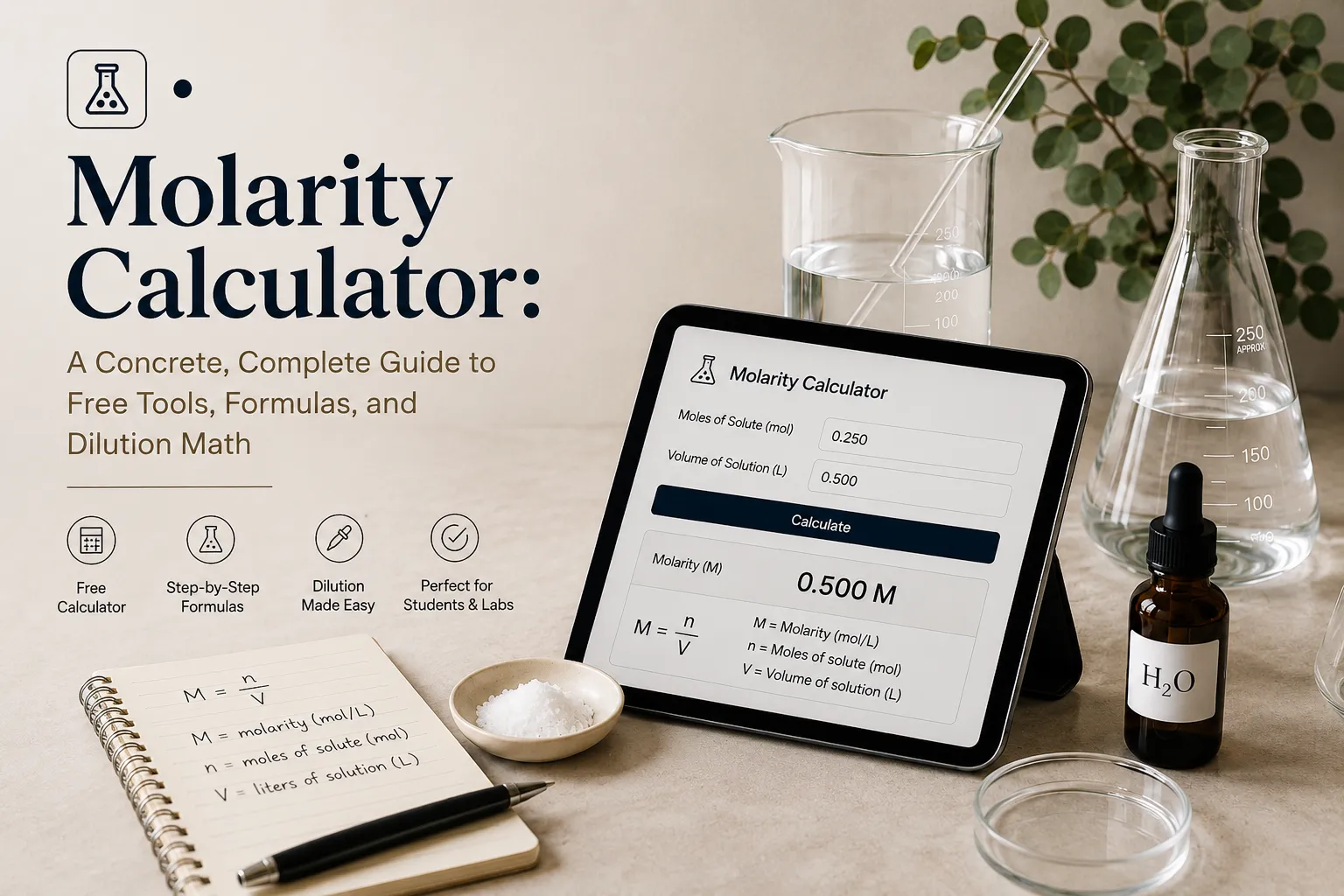
Chemistry students meet molarity early because nearly every solution-based experiment depends on it. A molarity calculator turns a formula that once took several manual steps into one quick result, which matters when a lab schedule leaves no room for arithmetic mistakes. Students use molarity to prepare accurate solutions for titrations and reactions. Laboratories use it to standardize reagents so results stay reproducible across technicians and days. This guide explains what molarity means, how the formula works, how to calculate it by hand, and where a calculator saves real time. By the end, you will understand the chemistry well enough to check any calculator result yourself.
What Is Molarity
Molarity measures how much solute dissolves in a fixed volume of solution. It is defined as the number of moles of solute divided by the volume of solution in liters. Chemists write it as M, and its SI unit is moles per liter (mol/L). A one molar solution contains one mole of dissolved substance in every liter of solution. Molarity matters because it lets scientists compare concentrations across different solutions using one consistent standard. Without it, a chemist could not predict how a reaction behaves, since reaction rates and yields depend directly on the concentrations of the reactants. Molarity forms the foundation for calculations used in titration, dilution, and solution preparation.
What Is a Molarity Calculator
A molarity calculator is a digital tool that applies the molarity formula automatically once you enter known values. Instead of solving the equation by hand, you enter moles and volume, or mass and molar mass, and the calculator returns the concentration in seconds. The main benefit is accuracy, since a calculator does not make arithmetic slips the way a tired student might during a late study session. It also saves time during long laboratory sessions where several solutions need preparing. Teachers use it to check homework quickly, and researchers use it to confirm calculations before committing to costly reagents.
Molarity Formula Explained
The molarity formula is written as M equals n divided by V, where M stands for molarity in moles per liter, n stands for moles of solute, and V stands for volume of solution in liters. Each variable plays a distinct role. Moles measure the actual amount of substance present, calculated from mass divided by molar mass. Volume measures how much space a substance occupies once dissolved, and it must always be in liters, not milliliters, for the formula to give a correct answer. A common source of confusion is using the volume of solvent instead of the volume of the finished solution, since dissolved solute changes the total volume.
How to Use a Molarity Calculator
Using a molarity calculator follows a simple sequence.
Identify what you already know, either moles and volume, or mass, molar mass, and volume.
Convert every volume measurement into liters before entering it, since mixing milliliters and liters gives a wrong result.
Enter the moles of solute, calculating it first from mass divided by molar mass if you only have the mass.
Enter the volume of the final solution, not the volume of solvent alone.
Read the result in moles per liter and compare it against your expected range to catch obvious input mistakes.
This sequence works whether you calculate by hand or let a calculator handle the arithmetic instantly.
Real Life Calculation Examples
A classroom example makes the formula concrete. A student dissolves 0.5 moles of sodium chloride into enough water to make 2 liters of solution. Dividing 0.5 by 2 gives a molarity of 0.25 mol per L.
A laboratory example looks slightly different. A technician weighs 5.85 grams of sodium chloride, which has a molar mass of 58.5 grams per mole, giving 0.1 moles. Dissolving that amount into 500 milliliters, or 0.5 liters, of solution produces a molarity of 0.2 mol per L.
A pharmaceutical example follows the same logic at a smaller scale. A pharmacist preparing an intravenous solution might dissolve 0.02 moles of a drug compound into 200 milliliters of saline, giving a molarity of 0.1 mol per L, a concentration precise enough to matter for patient safety.
A biology example applies molarity to buffer preparation, where a researcher dissolves a set number of moles of a buffering agent into a fixed volume to keep an experiment at a stable pH throughout an assay.
Common Applications of Molarity
Chemistry laboratories rely on molarity to prepare standard solutions for titrations and reactions where precise concentration decides the outcome. Medical laboratories use it to prepare reagents for blood and diagnostic testing, where small concentration errors change results. Pharmaceutical companies depend on molarity to formulate medications at exact, safe concentrations. Environmental testing labs use it to prepare calibration standards when measuring pollutants in water or soil. Food science labs apply molarity when testing preservative levels. Research laboratories across biology, chemistry, and physics use molarity daily, since most experiments involve some form of solution.
Common Mistakes to Avoid
Many calculation errors come from small, avoidable slips. Using milliliters instead of liters produces a result off by a factor of one thousand. Forgetting to convert mass into moles before dividing by volume gives a meaningless number, since molarity requires moles, not grams. Confusing molarity with molality leads to using the wrong formula entirely, since molality divides by kilograms of solvent rather than liters of solution. Rounding too early in a multi-step calculation introduces small errors that compound by the final answer. Using the volume of solvent added rather than the final solution volume also changes the result, since dissolved solute increases total volume in many cases.
Molarity Versus Molality
Molarity and molality sound similar but measure concentration differently. Molarity divides moles of solute by liters of solution, while molality divides moles of solute by kilograms of solvent. This difference matters because volume changes with temperature, while mass does not, so molality stays constant across temperature changes and molarity does not. Laboratories working with temperature-sensitive experiments often prefer molality for this reason, while everyday chemistry and most classroom problems use molarity because it is easier to measure with standard lab glassware.
Feature | Molarity | Molality |
|---|---|---|
Definition | Concentration per liter of solution | Concentration per kilogram of solvent |
Formula | M equals n over V | m equals n over kg of solvent |
Units | mol per L | mol per kg |
Applications | Titrations, general chemistry | Freezing point and boiling point studies |
Advantages | Easy to measure with standard lab glassware | Stays constant when the temperature changes |
Benefits of an Online Molarity Calculator
An online molarity calculator saves time during busy lab sessions where every minute matters. It improves accuracy by removing manual arithmetic, which matters most when preparing solutions for sensitive experiments. Beginners benefit because the tool reinforces the formula visually while still returning a fast answer. It also reduces manual errors that come from unit conversion mistakes, one of the most common sources of wrong results. Students use it to check homework before submission, and researchers use it to confirm calculations before ordering costly reagents. Used alongside a solid understanding of the formula, the calculator becomes a verification tool rather than a replacement for learning chemistry.
Experience-Based Tips
After years of running solution preparation in a teaching lab, a few habits consistently prevent errors. Always check units before starting any calculation, since a single missed conversion invalidates the entire result. Convert milliliters to liters early, before plugging numbers into the formula, rather than converting at the end. Double-check mole values independently, especially when mass and molar mass calculations feed into the final answer. Keep units consistent throughout every step of a multi-part problem. Verify the final answer against a rough estimate, since an answer that is off by a factor of ten usually points to a missed unit conversion.
Fast Response and Stable Layout
A molarity calculator only helps if it responds quickly and stays visually stable while a student works through a calculation. Fast input processing keeps interaction to the next paint low, so results appear almost instantly after a value is entered, which matters most on mobile devices during lab work. Lightweight scripts prevent the page from freezing on older devices, common in school computer labs. A stable layout, with fixed space reserved for the result section, prevents the page from jumping around as numbers load, which stops accidental taps and keeps trust in the tool. These details improve both user experience and search ranking.
Conclusion
Molarity remains one of the most practical concepts in chemistry, connecting classroom formulas to real laboratory work. A molarity calculator speeds up the arithmetic, but understanding the formula itself, moles divided by liters of solution, is what actually prevents mistakes when preparing a real solution. Use the calculator to check your work, not to skip learning the reasoning behind it. Once the formula feels automatic, a calculator simply confirms what you already know, which is the fastest way to build real confidence in a chemistry lab.
Frequently Asked Questions
Q: What is molarity?
Molarity is the concentration of a solution, defined as moles of solute divided by liters of solution, measured in moles per liter.
Q: How do you calculate molarity?
Divide the number of moles of solute by the volume of the solution in liters, using the formula M equals n over V.
Q: What is the molarity formula?
The molarity formula is M equals n over V, where M is molarity, n is moles of solute, and V is volume of solution in liters.
Q: What units are used for molarity?
Molarity uses moles per liter, often written as mol per L or simply M.
Q: What is the difference between molarity and molality?
Molarity divides by liters of solution, while molality divides by kilograms of solvent, and molality stays constant when temperature changes.
Q: Why is molarity important?
Molarity lets scientists compare and control concentration accurately, which affects reaction rates, dosing, and experimental results.
Q: Can I calculate molarity manually?
Yes. Convert volume to liters, find moles of solute, then divide moles by volume using the standard formula.
Q: Why should I use a molarity calculator?
A calculator removes manual arithmetic risk and returns an accurate result quickly, which matters during long laboratory sessions.
Q: What is a mole in chemistry?
A mole is a unit representing a fixed number of particles, roughly 6.022 times ten to the twenty-third, used to measure the amount.
Q: Is molarity used in laboratories?
Yes. Laboratories use molarity constantly to prepare standard solutions, reagents, and buffers with precise, repeatable concentrations.
Related Articles
Use our free Standard Error Calculator to find SE instantly. Learn the formula, step-by-step method and when to use standard error vs standard deviation.

Calculate cubic feet instantly with our free volume calculator. Enter length, width and height to get accurate cubic footage for any project.

Use an age calculator and Birthday calculator to get exact ages for forms, school cutoffs, plans, and leap-year dates, with fewer entry mistakes.

Discover the best scientific calculator online for fast, accurate math. Solve trigonometry, algebra, calculus & more free, no download needed.